
In 2023, I left a career in the United States to move back to Nigeria. A few years prior, I had started an admissions consulting business, on the side of my full-time job in tech, helping other Africans get into the top US business schools and thousands of dollars in scholarships. It was and continues to be very rewarding.
So when I returned to Nigeria, I figured I could make a similarly bold move and commit to education in my full-time role. I was introduced to The uLesson Group, Nigeria’s leading edtech company, and was quickly offered a role leading operations for its recently launched tertiary institution, Miva Open University. Now, I oversee operations for the entire Group comprising Miva and uLesson, our K12 business.
Since being back home, I’ve had conversations with a number of energetic young Nigerians passionate about education and wanting to return to Nigeria to contribute in some capacity. And the question inevitably arises: where? Where should young, energetic folks passionate about education think about working in Nigeria?
The question essentially asks for a map or menu. A guide of some sort into what different options are available. After a couple of conversations where this question has come up, I believed it would be helpful to put together a landscape map I could reference and some thoughts around that map.
So let’s get into it.
First things first
Since we’re talking about education, the first, most obvious way anyone can contribute to the space is to become an educator. This traditionally would have been confined to an institution, where a person would be a teacher/lecturer/professor. But today, with social media and the prevalence of the internet, anyone can be an educator and not necessarily be backed by or associated with an institution.
It’s the most foundational contribution a passionate individual can make – to inform, to explain, to teach, to create new bodies of knowledge. Even within institutions, there are alternatives to the traditional lecturer path. For example, there are professors of practice, entrepreneurs in residence and other exceptional individuals working as educators through our university.
So that’s the first question, do you want to be an educator?
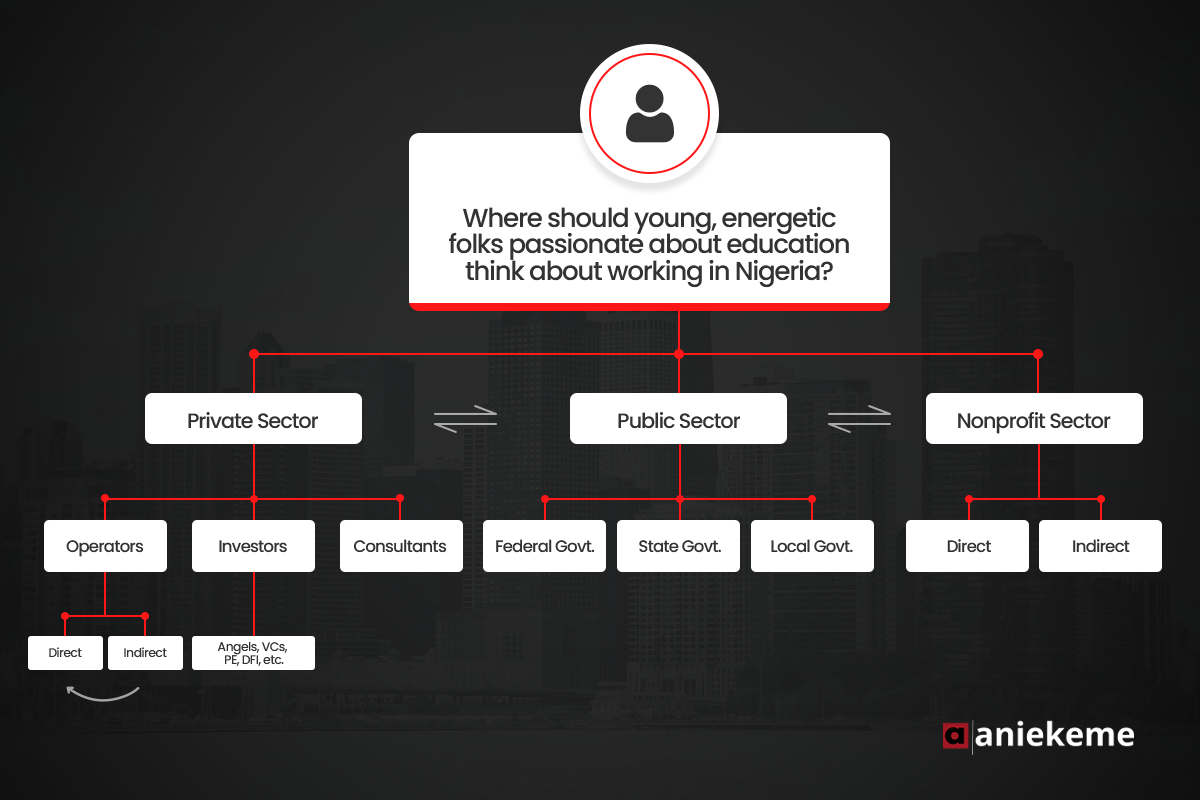
Setting that aside, the map below breaks down various categories of the education landscape and where you can choose to plug in.
Private vs Public vs Nonprofit Sector
Perhaps the next most important question to consider is whether you’d like to work in the private, public or nonprofit sector. It’s typically an easy answer for folks as they are such different spaces. Some key considerations in making this decision: pay, speed of execution, bureaucracy and reach.
As a business school graduate accustomed to a certain level of pay, autonomy and speed of work, and energized by an entrepreneurial and capitalist bent, I knew I would work in the private sector (to start, at least). Here, I’ll give a disclaimer: if you’re moving from the US to work in Nigeria, brace yourself for a pay cut, regardless of sector. There are perks an employer can offer that can help cushion the blow a little bit, and sure cost of living would be lower, but you’d still be making a financial sacrifice.
There are a number of multilateral organizations (like UNICEF and The Global Partnership for Education) and private foundations (like the Bill & Melinda Gates Foundation and the Mastercard Foundation) doing work in education in Nigeria. I can imagine a transition into public sector work via one of those organizations or nonprofits. Of course, the field is open for you to choose based on your background and interests.
PRIVATE SECTOR
Operators
This category covers entrepreneurs (who must be operational in the early stages of their business) and all employees involved in the day-to-day running or management of a business in the education sector. Operators may function directly or indirectly in this space.
> Direct Private Operators: these are folks who provide educational services. Their businesses include nursery, primary and secondary schools, polytechnics, universities, teaching institutions, online academies, etc. They give a direct educational service to their customers so that the degree of separation between them and the consumer of education is zero.
> Indirect Private Operators: these are folks who support those providing educational services. Their businesses include technology providers of student information systems, learning management systems, proctoring tools, computer-based test centers, learning hardware, teacher trainings, etc. They indirectly impact the education consumer, through the direct private operators (and also sometimes through the public and nonprofit sector – as they offer a service paid for by the government or a philanthropic organization). Their degree of separation from the consumer of education is greater than zero.
As an operator, you are closest to the people you are solving for. This makes your impact more tangible and that can be incredibly rewarding.
Investors
This category covers all those who commit capital to the education sector with the expectation of a return on their investment. Investors may be individual angels, venture capital firms, private equity firms, family offices, direct foreign investment vehicles, etc.
Investing can be a great entryway into making an impact in the Nigerian education sector as you can start investing before stepping foot in the country. Investing in education is an essential part of solving the massive deficits and rewriting the education trend in Nigeria. As an investor, you’ll be exposed to a plethora of businesses and ideas, and backing the right ones, you’ll get to see the impact of your capital.
Consultants
Consultants are an important part of the education ecosystem. They can serve as advisors to private operators and investors, public sector officers and as a connector between the private, public and nonprofit sectors. This category covers individual consultants as well as large consulting companies like McKinsey who take on projects in the education sector.
PUBLIC SECTOR
The role of the government in education cannot be overstated. Without a functioning government with policies and enforcement in place, there is no backbone to the education system. You may be interested in working in the government at the federal, state or local government level.
Federal
This covers the Ministry of Education and the agencies it oversees, including the Universal Basic Education Commission (UBEC), the National Universities Commission (NUC), the National Board for Technical Education (NBTE), the Tertiary Education Trust Fund (TETFund), examination boards like the National Examinations Council (NECO) and the West African Examinations Council (WAEC), amongst others. I’ll do a deeper dive into the mandate of the Ministry of Education and its supporting agencies in a subsequent article as it needs a full exposition in and of itself.
On the federal level, the National Assembly, particularly the House and Senate Committees on Education also plays an important role, by approving budgets, overseeing policies and ensuring accountability of the Ministry of Education.
State
This covers the offices of the Commissioners of Education and State Universal Basic Education Board (SUBEB), responsible for education in each state. These offices and boards work closely with the governors and federal bodies to meet their goals. While the federal level of public sector work gives you breadth of impact, the state and local level can give you depth, being closer to the direct consumers of the work. In the same detailed article I mentioned above, I will flesh out the role of the state government and its place in the education public sector landscape.
Local
Local governments are responsible for basic education, primarily through the Local Government Education Authority (LGEA) which sits under SUBEB. Previously, local governments yielded little power over their involvement particularly with respect to paying salaries, but a recent change to regulation has empowered all 774 local governments across the country. Besides working as a private direct operator, working at the local government level is the closest you’ll get to the people you would be making an impact on. It’s important grassroots work and will also subsequently be covered in even more detail.
NONPROFIT SECTOR
This category covers organizations operating charitably through donations and grants to impact education in Nigeria. There are large multinational nonprofits in the space, as well as smaller homegrown NGOs. Where education is concerned, these organizations may operate directly – through the establishment and administration of free schools and educational resources, etc. or indirectly – through the provision of scholarships, the establishment of community support and the reduction of the barriers that prevent access to education.
The nonprofit sector interacts a great deal with the private and public sectors. Some grant-making bodies fund federal, state and/or local government agencies, who then may work with private sector players on execution. Some nonprofit organizations make their charitable contributions directly to private sector organizations, often earmarked for specific uses, like scholarships or research and development.
If you’re developmentally inclined, this can be a great place to enter into the education sector. Depending on the size of the nonprofit organization, you could enjoy a lot of satisfaction in interacting directly with your target demographic or if a larger organization, the satisfaction of broader / farther-reaching impact.
This map is a great place to start. In addition to delineating the different sectors, it also highlights how these different sectors interact with each other. And that, to me, is a key takeaway. For the work that must be done to solve for education in Nigeria, we need all sorts of players in the space.
As a private direct operator, The uLesson Group exemplifies the kind of intersection that exists between private, public and nonprofit sectors. We are private operators regulated by the government (Miva secured its university license from the National Universities Commission), doing business with the government (uLesson partnered with the Niger Delta Development Commission to provide 45,000 learning tablets in the country’s largest edtech investment), and leveraging funding from charitable foundations to accelerate technology and R&D for the betterment of education access and outcomes in Nigeria.
Thanks for reading. Stay in touch with me via LinkedIn to be informed when there’s a new article published. And feel free to contact me for speaking and other partnerships.
Aniekeme