Commentary on the book, The New Global Universities: Reinventing Education in the 21st Century by Byran Penprase and Noah Pickus.
I walked into the class at Philosophy Hall with my printed copy of Foucault1 in hand, not knowing what to expect. “Close reading” was what we were asked to do in preparation for the class. What did that even mean? I had no idea.
As my Nigerian primary and secondary school education had trained me to, I had read the entire piece of work and memorized some parts in case I needed to recite it to the class. As if a mandatory class called University Writing at a liberal arts institution like Columbia University would be about how much you could cram and regurgitate.
One of the first questions our instructor, Joseph Cermatori, asked was: What are your thoughts on Foucault’s argument? I was actually speechless. I had no proper thoughts on it, nor did I know I was not only allowed to but expected to. It turned out “close reading” meant we were to deeply engage with the text, challenge its arguments, build on its ideas and be prepared to defend and dialogue on it.
It was my very first semester at Columbia and the beginning of weeks spent in the university’s Writing Center, getting support from the staff there, as I completed this foundational class. Week after week, we were given texts from philosophers and writers, we engaged in debates and wrote a lot – not to reproduce what we had read or heard, but to share our unique perspective on a variety of topics.
I credit a lot to the liberal arts education I received at Columbia. Even though I majored in chemical engineering, I was required to take classes outside of that field to fulfill my graduation requirements. These classes, like Major Debates in the Study of Africa, East Asian Buddhism, The Interpretation of Culture, amongst others, challenged my assumptions, exposed me to new ideas, pushed me to think critically and trained me to be a competent communicator.
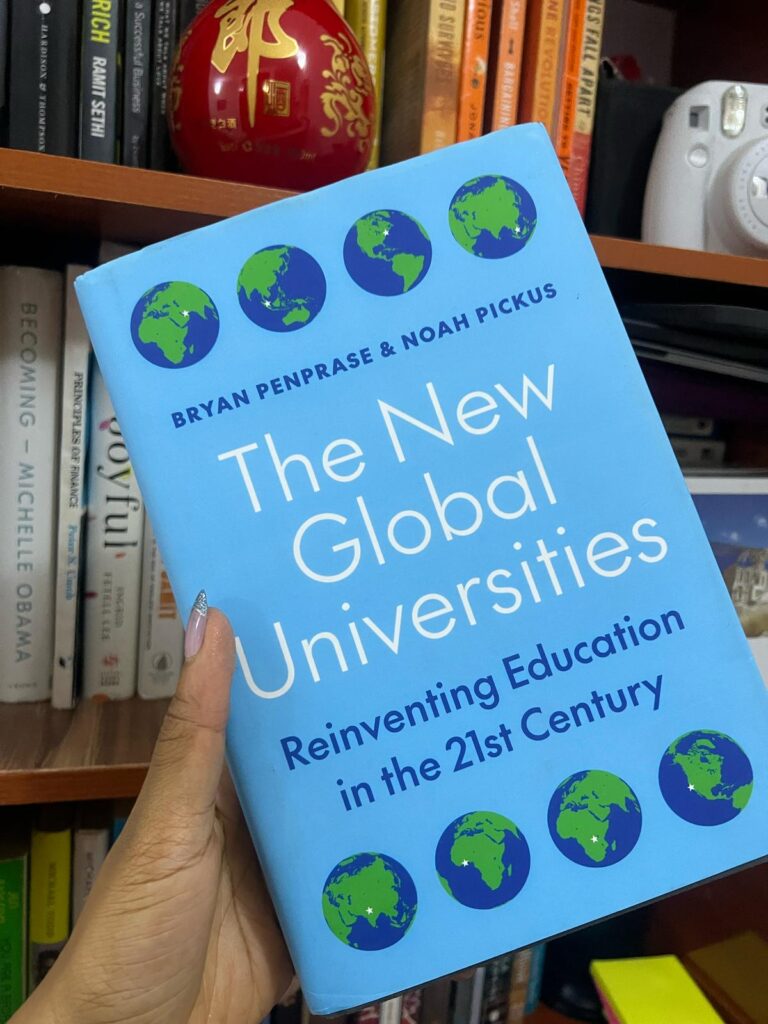
Last year, I was introduced to Linda Zhang, a fellow global education leader, and she recommended a book, The New Global Universities: Reinventing Education in the 21st Century. I finally got around to reading it this month.
In it, the authors detail the development and launch of eight universities across the globe, most bringing the same liberal arts education I greatly benefitted from to new parts of the world and others innovating higher education in completely new ways. It was such an insightful read, especially as we continue to build Miva Open University, Nigeria’s first private online university, democratizing access to a high-quality education and equipping learners with in-demand skills for the modern workforce.
The eight universities chronicled are:
- NYU Abu Dhabi (United Arab Emirates)
- YALE-NUS College (Singapore)
- Olin College of Engineering (United States)
- Fulbright University Vietnam (Vietnam)
- Ashoka University (India)
- Ashesi University (Ghana)
- African Leadership University (Mauritus and Rwanda)
- Minerva University (United States/Global)
For anyone working at a challenger university2 or interested in learning more about new innovative tertiary institutions, I highly recommend a read. As a primer, I’m sharing ideas that stood out to me and questions I still have with respect to each institution documented in the book.
1 NYU Abu Dhabi
The following fall semester, the NYU Abu Dhabi faculty voted for a new structure of the common curriculum, reducing it to just six courses. The new curriculum design aimed to bring “plenary moments” to the core program, which could be a guest lecture, film screening, art exhibit, or other performance, and would serve to bring the community together to consider common themes at key moments. The new design consisted of two core colloqiums focusing on global challenges, and then one course selected from each of four areas: art, design, and technology; cultural exploration and analysis; data and discovery; and structures of thought and society. The compromise enabled the four area courses to provide a wide mix of disciplinary perspectives, but also included the interdisciplinary colloquium courses that addressed “profound and enduring questions” with an emphasis on “significant global challenges.” (Highlights are mine.)
+ Is a liberal arts education still worthwhile in today’s world?
+ Where does one draw the balance between it and pre-professional degrees, especially in a region where there’s such a deficit in training for the existing jobs?
+ How much can and should a university’s environment influence its offerings and especially change what it desires to be its core DNA?
2 Yale-NUS College
In the words of the 2013 Curriculum Report, Yale-NUS College was designed with “a focus on articulate communication,” “open, informed and reflective discourse,” and “conversation” between individuals as the primary element of learning, just as in ancient times. As the report put it, “among the goals of a college curriculum is to help students make sense of that experience together, through a set of conversations about some of the most fundamental questions and problems of human existence.” (Highlights are mine.)
+ How do you deploy a liberal arts curriculum at scale, given the amount of group work and close teacher interaction needed for an effective programme? If AI, would and if so, how soon would its outcomes match those of real humans?
+ How does an institution in a joint venture maintain alignment with its co-institution and the government of the country in which it operates to ensure there are no sudden changes to the vision and identity of the institution?
+ How can the value of a liberal arts education be more convincingly and widely understood? Especially when its name doesn’t properly convey what it actually means?
3 Olin College of Engineering
This was my favorite chapter so far. It’s amazing that Olin college, within 10 years of existence, has risen to comfortably occupy the #2 spot for best undergraduate engineering program, and sometimes tying with MIT for #1.
The traditional engineering curriculum, with its hierarchical nature and emphasis on applied science, is like classical music, he argues: it teaches students to reproduce the notes that Beethoven wrote two hundred years ago, and you do this exactly the same tempo and everything that he did.” Useful to a point – but not conducive to discovery and innovation. Olin’s curriculum, in contrast, operates more like jazz, and as Miller says, “jazz has to start from inside and is more of an extemporaneous conversation than a recital.”
+ Given how efficacious project-based learning is, why isn’t it as prevalent in universities across the world?
+ How can the Design and Project process so elegantly used at Olin be applied to a business education? A public administration education?
4 Fulbright University Vietnam
The story of this institution had similar themes with Olin College and its codesign year and with Yale NUS with respect to questions around the identity of the university.
I have just one question:
+ When trying to create something new for a market that hasn’t ever experienced it, do we over or underestimate how ready the society is for change?
5 Ashoka University
This case study feels most similar to the educational and socio-economic context with Miva in Nigeria – a rigid education system that limits exploration and speedily commits you to a degree you may or may not flourish in.
The YIF thus filled the gap between the founder’s aspirations to launch quickly and the reality that regulatory approvals and construction would take years. This interim period proved to be crucial in other ways as well. Each YIF student was sponsored by a single donor, a structure that helped recruit supporters and build a culture of philanthropy. As donors witnessed the quality of the students and the increasing selectivity of the program, they became attached to the group’s mission, making it easier for the founders to ask them to write bigger checks as they began to build the university. The graduates of the first class and subsequent classes themselves became compelling spokespersons for the future Ashoka University – and a dynamic network for recruiting future students.
+ Is there a viable financial model for a high quality education in a country with a low average earnings and at an institution without the kind of endowment of an established U.S. university, able to offer even more generous financial aid — so you’re really reaching the underserved, not just those who were more recently priced out of attaining an education overseas, but those for whom that was never on the table?
6 Ashesi University
The residential beginnings of the university in a city outside of Accra remind me of the stories of uLesson’s beginnings in Jos.
From these discussions the team designed a curriculum based on professional majors but with a core curriculum in humanities, social sciences, math, and other liberal arts subjects – to be taught in a way that avoided rote memorization and repetition and encouraged thinking for oneself. This new Ashesi curriculum would not be an African version of Swarthmore, but instead would remove the separation between professional skills and traditional liberal arts subjects. (Highlights are mine.)
I’m inspired by Ashesi’s rankings – the only private university in Ghana that is globally ranked – and the outcomes they’ve been able to get for their students. That Ashesi is determined to maintain a small student size and measure scale as the outsized impact those well-trained sets of graduates have on the Ghanaian, African and global societies, begs the question:
+ How can what has worked for Ashesi be applied at scale?
Also,
+ I’m keen to see how leadership transition happens when their founder steps down — is Ashesi a steady-state institution at this point or do they need another visionary to take on the mantle, and what will end up happening?
7 African Leadership University
It’s so cool how products are often the result of their founder’s experiences — what went well and/or what they would have liked to do better. This institution, with their vision the authors communicate as “a global solution, African born”, is perhaps the most ambitious one so far. From African Leadership Academy (ALA) to African Leadership University (ALU) to African Leadership Experience (ALX), all running concurrently as a suite of non-profit and for-profit institutions.
My favorite part of this chapter was the founder coming to the aha moment that scale can only come if a predominantly online approach is applied. This leads to a significantly reduced cost for the institution, translating to a more accessibly priced offering for students, allowing those who were previously priced out of a great education the opportunity to earn one.
Swaniker likes to ask his audiences, “How many of us remember specific things we learned in college or graduate school?” Rather than content, he says that what most students remember are the relationships they forged and the specific skills they got a chance to practice. The ALU designers set out to translate this relationship-and skilled-based vision into a curriculum. The curriculum designers surveyed 150 companies in different parts of the world to identify the skills they found were missing when students arrived at work from college. The designers mapped seven overarching skills which they grouped into four categories–how to think, how to be, how to do, and how to learn–and broke down further into 135 specific learning outcomes.
+ I’m curious how the updated models for ALU have worked so far. Case studies of success come from their first class of graduating students; how about subsequent classes? And most especially, how about the classes after the model was changed?
+ I wonder, what is the business justification and perhaps unseen long-term vision behind building or wanting to build learning centers in the U.S. when ALU students are mostly on the continent?
8 Minerva University
Minerva is brilliant. Amazing stats, very unique and intentional model. And there’s validation in the outcomes of their graduating students. Minerva is similar to ALU in the non-profit meets for-profit model.
This question led Nelson to seek the brand prestige of Havard’s president. He understood that in contrast to the world of commerce, the currency of higher education is status not money, New entrants in this market can’t simply succeed by improving efficiency because no one actually knows what is being purchased: College is a veritable black box of research, education, coming-of-age experiences, athletics, and ultimately, reputation. As former George Washington University President Stephen Trachtenberg memorably put it “College is like Vodka”–a flavorless beverage that people will spend more on if it comes with a brand name because that name signals something about the buyer not about the product.
+ A key challenge that would emerge for Minerva would be maintaining the quality of high-touch, in-depth feedback given to each student as the student population grows. Will Minerva embrace AI in this arena?
+ How will Minerva make its business model work, especially with the high cost of running residential experiences in seven cities across the world, while trying to keep tuition fees low? There’s a tension here between being able to scale those sorts of experiences (to unlock the cost savings of scale) and still maintain the high-touch student experience standard the university has set for itself.
My closing thoughts:
First of all, I deeply commend the founders, investors, supporters and early operators of all eight of these universities. They battled challenges to birth their institutions and the world is better for it.
Secondly, I’m grateful to the authors and their assistants for the hard work they put into researching and writing this book. It truly is a gem, and I believe it will endure as a reference text for future builders in the tertiary education space.
Finally, I am even more energized about our mission and vision at Miva Open University. Because we are an online university, we are able to really scale (we’re at 8,200+ students in a little over 18 months). Because we are technology-first, we are innovating at a rapid rate, bringing increased efficacy to our students’ learning experiences. And we’re just getting started.
Thanks for reading. Stay in touch with me via LinkedIn to be informed when there’s a new article published. And feel free to contact me for speaking and other partnerships.
[1] Paul-Michel Foucault was a French philosopher and writer whose ideas focused on knowledge and power and who was associated with the structuralist and post-structuralist movements.
[2] A challenger university is a new university that leverages technology to innovate the student experience, curriculum, and/or business model of a traditional university.
Thanks for reading. Stay in touch with me via LinkedIn to be informed when there’s a new article published. And feel free to contact me for speaking and other partnerships.
Aniekeme