In 2020, I graduated from Wharton into the global pandemic. It was conceivably not a great time to leave business school without a job offer in hand. It wasn’t until April 2021 that I landed a full-time role in tech at Peloton. With just this information in mind, I would have been a part of the “unfortunate elite MBA graduates who are struggling to land a job months after graduation.” But that isn’t the full picture. It rarely ever is.
Before business school, I had declined a sponsorship offer from the consulting firm I was working at, to return there after I graduated. The summer between my first and second year, I worked in investment banking and received a full-time offer to return post-graduation and turned that down as well (learnt a lot but IB 100% wasn’t for me). Months before our virtual convocation ceremony, I was being recruited by Google for a role in the Bay Area, but cancelled that process because I wanted to return to New York City, where I lived before business school and still had an apartment.
Now, without formal experience in the fashion / retail space, and leveraging learnings from one of my favorite Wharton classes – Strategic Brand Management – I set up a personal website, speaking convincingly about my passion for the fashion and retail industry. I created a helpful landscape of the fashion technology ecosystem and off the strength of my network (hello Wharton), was able to get 3 different offers in the space, including a full-time role. I worked with the CEO of Sean John to get 4 new black fashion brands into Target, worked with Re–inc to launch their Fall/Winter 2020 non-apparel collection, and worked full-time as interim vice president of finance and operations at Stone and Strand, a jewelry company in NYC.
How fortunate was I to have a breadth of experience in an industry I was curious about, without prior training in that space? It allowed me to very quickly realize that as much as I loved fashion, I didn’t feel particularly fulfilled working in the space.
Would I have gotten those 3 offers if I hadn’t been a Wharton grad? Likely not, as they all came from that network. There’s a level of inherent trust a name like Harvard or Stanford or Wharton gives, that combined with your dedication and strategic effort, makes it possible for great opportunities to open up for you.
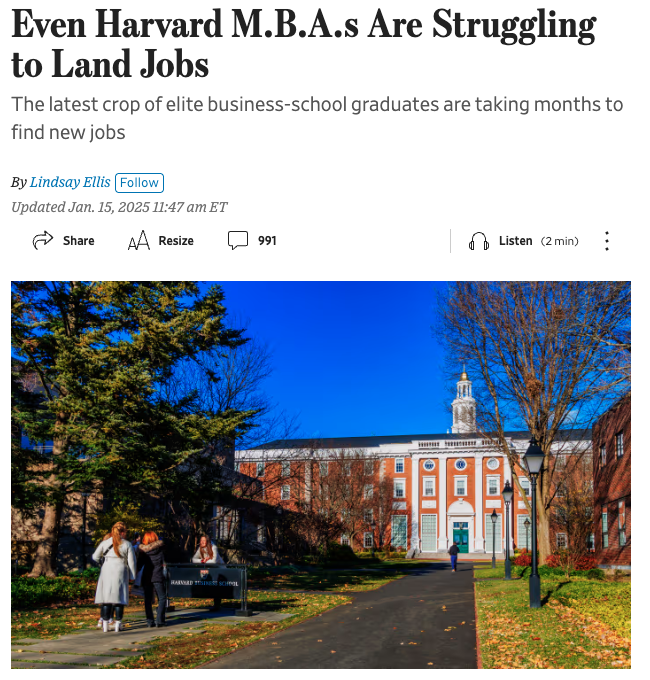
So back to the headlines “Even Harvard M.B.A.s Are Struggling to Land Jobs”…How much of this is data-backed and how much of it is written to drive clicks?
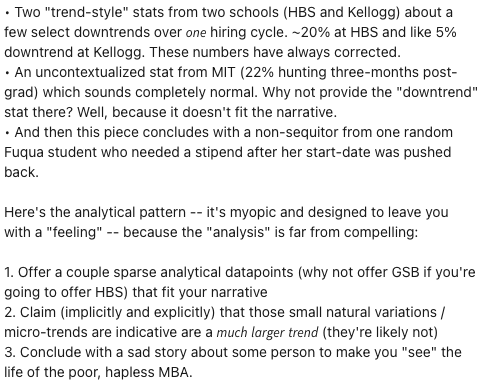
I like Ben Lazaroff (GSB grad, coach, founder and startup advisor)’s brief commentary on the analytical framework of that particular Wall Street Journal article:
A countertrend is that MBA applications have surged 12% between 2023 and 2024 and are projected to increase again in 2025. So yes, it is a tough job market right now and that’s also showing up within the pool of MBA jobseekers, but the appeal and demand for an elite MBA isn’t going away anytime soon.
Here’s a brief summary of my perspective on this:
[1] Elite MBA grads can afford to be picky – they can wait a few months post-graduation for the best-aligned opportunity.
[2] Elite MBA grads have a network they can fall back on – when it comes down to it, they can lean on classmates and alums to get access to opportunities, sometimes before those roles are ever publicly posted.
[3] Elite MBA grads still need to do the work to differentiate themselves – this might be some prototyping, market research publication, personal branding, etc., to show a keen interest in and alignment with the opportunities they’re seeking.
[4] Elite MBA programs need to evolve to respond to the change in workforce demands – the curriculum needs to continuously adapt to cover emerging technologies and specializations that matter most in the job market.
[5] Elite MBA programs will do what is necessary to remain relevant and value-additive – they will innovate and adjust as needed to preserve their 100+ year legacies for several more years to come.
What do you think?
Thanks for reading. Stay in touch with me via LinkedIn to be informed when there’s a new article published. And feel free to check out our MBA admissions consulting practice for support with getting into an elite US MBA program.
Aniekeme